History of Gas Turbine Engines, Aerodynamics Laws and Types of Gas Turbine Engines
Gas turbine engines have transformed modern aviation, making faster, safer, and more efficient air travel possible. The sample essay below traces their development from the earliest scientific discoveries to the sophisticated propulsion systems used in today's aircraft, while also explaining the aerodynamic principles that make these engines work. It offers a clear overview of the history of gas turbine technology, the physics behind thrust generation, and the major engine types used across aviation and industry. Whether you're researching aircraft propulsion or looking for a well-organized example of a technical essay, this paper can serve as a useful reference. And if you need a custom engineering paper tailored to your assignment requirements, our expert paper writers are always ready to help you produce original, high-quality academic work.
Introduction
Gas turbine engines are one of the most important inventions in the history of aviation and engineering. They are used in a variety of different aircraft and even power plants. To understand how such engines are both made and function, it is important for those studying aviation and engineering to understand the history of these engine designs and the laws of physics that impact their function. The examination of each of these aspects, the history of gas turbine engines, the laws of physics that impact their function and the different types of gas turbine engines that are used in various applications today, all provide a thorough understanding of the topic and elements of gas turbine engines overall.
The development of the gas turbine engine was not overnight. For hundreds of years, scientists and engineers from all over the world have been conducting experiments and improvements to gas turbine engines. From the toy made by an ancient Greek engineer to today's airliners and jet engines, the gas turbine engine has seen remarkable developments over the years. The purpose of this paper is to review the history of such an engine clearly and simply.
Aerodynamics is used to generate thrust from gas turbine engines. The movement of air from the engine and the production of thrust is explained via Newton's Laws of Motion, Bernoulli's Principle and the Law of Conservation of Energy. Each of these laws is simple to understand and helps clarify the performance of gas turbine engines as a power source.
Lastly, the four major types of gas turbine engines - turbojets, turbofans, turboprops and turboshafts - have all been discussed; thus, each of these has unique applications and works in different ways. In summary, the objective of the paper has been to give a comprehensive analysis of gas turbine engines right from their inception to the present day.
History of Gas Turbine Engines
Ancient Beginnings
The history of the gas turbine is even further ahead in the past than most people think. In the 1st century AD, the Greek mathematician and engineer Hero of Alexandria invented the aeolipile (Hughes, J. Donald, 2023). This invention used steam from heated water to push water out of the sphere through two nozzles attached to it, causing the sphere to often spin. It was the first known instance of the reaction principle.
There was no particular use for this invention; it was essentially a toy. However, the principle upon which it was based would be the same as that of the modern jet engine, thousands of years away from invention. Thus, the science behind gas turbines is ancient history - even if the technology took a very long time to develop (Giampaolo, 2020).
Another of the earliest examples of a device that utilizes the concept of the flow of gases to perform work is Leonardo da Vinci's. Around the year 1500 AD, da Vinci devised a means of utilizing a device in the chimneys of homes' kitchens (Rochem Fyrewash, 2024). This device, known as the chimney jack, used the hot air emerging from the fires within such chimneys to turn a series of fan-like blades connected to a spit that could roast meat in kitchens and homes. Thus, da Vinci invented a device that worked on essentially the same concept of gas movement as the steam engine. While this device was utilized for the relatively simple task of roasting meat for human consumption, the invention was still importantly related to the consideration of using gases to perform work.
17th to 19th Century Developments
In 1629, an Italian engineer, Branca, invented what would prove to be the first impulse turbine. Branca invented this by allowing steam to exit a nozzle and hit a turbine wheel, which would then turn a set of gears that could power a crushing mill. Thus, Branca created one of the first machines to utilize a gas stream to turn a wheel (Guide, 2025). While relatively simple, such creations would serve as the basis of both steam and gas turbines as well as numerous engine systems employed throughout industry and aviation today.
Another important contribution to the science behind gas turbines was made in the 1600s, specifically by Sir Isaac Newton (Dr. Iyad Al-Attar, 2020). The scientist published his three laws of motion in 1687, all of which would have a major impact on those trying to theorize as to how jet engines would generate such thrust. These laws provided scientists with the tools necessary to understand forces - knowledge essential for understanding the science behind jet engines. Each of these laws remains applicable in the science and engineering fields today, particularly in the creation of jet engines and gas turbines (Eckardt, 2023). Without these concepts from Newton, it would have been difficult to create so many of those engines with such accuracy.
During the 1800s, there were several inventors who carried out experiments on turbines driven by either steam or gas. The experiments led to the acquisition of important information on how to enhance turbine efficiency (APG, 2024). The engineers gained knowledge of compressors, combustion and thermodynamics. While no successful gas turbine engines were designed during this time, foundations had been set for future innovations. The insights gained from such experiments proved to be very valuable as scientific knowledge increased; the capability to overcome previous engineering limitations increased.
Early 20th Century and the Birth of the Jet Engine
In 1903, Norwegian engineer Aegidius Elling created the first gas turbine to run under its own power (Britannica, n.d.). The gas turbine created more power than it consumed - something never seen before. Such efforts thus represented a major milestone in the development of gas turbines. While not powerful enough to have much use worldwide, Elling did develop the first working gas turbine (Mevissen et al., 2025). These efforts represented a major development within the field and indicated the possibility of further developments in gas turbines. Such knowledge helped to encourage others to make similar improvements to the engine and performance.
Dr. A. A. Griffith developed important work on the theory of gas movement through turbines as early as 1920 (St John’s College Access, 2021). This type of research significantly informs future engineers regarding the creation of turbine blades for such engines. While experiments were underway in turbine laboratories at the time, such theoretical efforts were equally important to establishing the technology. It led to a better understanding of how to develop gas and jet turbines - knowledge that would ultimately give rise to such developments worldwide.
The biggest breakthrough with jet engines came in the 1930s. In January 1930, the British officer Frank Whittle filed a patent for a gas turbine engine for jet propulsion. This engine contained components like a compressor, combustion chamber, turbine and nozzle. Despite difficulties securing funding for such an endeavor, Whittle successfully tested his gas turbine engine on April 12, 1937 (GE Aerospace, 2018). Though the engine would not yet be contained within an aircraft, Whittle's efforts proved the concept would work. These efforts would prove a major turning point in aviation history and for future engine designs worldwide.
At the same time, German physicist Hans von Ohain was also developing a similar design to Whittle's. Von Ohain had patented such a design in 1935, but would join aircraft manufacturer Ernst Heinkel in that same year. By September that year, he had developed a jet engine powered by conventional fuel. He installed this engine into a Heinkel He 178 aircraft, which, on August 27, 1939, would be the first aircraft of any type to feature jet propulsion (Walter James Boyne & Bilstein, 2018). These accomplishments by von Ohain, alongside the developments of Whittle, would officially mark the arrival of the jet engine in aviation technology.
World War II and Post-War Development
The Second World War would spur rapid advancements in gas turbine technology. Both Germany and Britain were keen to develop jet-powered aircraft (Patel, 2019). Germany would create the Messerschmitt Me 262 jet fighters using Junkers Jumo 004B engines, while Britain developed the Gloster Meteor using engines based upon Whittle’s design, all indicating to the military branch of the armed forces that jets would be the future of aviation (Magazine, n.d).
Following the war, jet technology began to spread throughout Europe, Asia, the United States and the Soviet Union, all of which would develop their own types of jet engines based upon these German and British designs. At this time, commercial aircraft began to adopt jet engines in the 1950s. The introduction of the Boeing 707 in 1958 would mark the start of the commercial jet age (Pan, 2025).
In the period of the 1960s to 1970s, aircraft manufacturers were designing new engines that should have been fuel-efficient and quiet in performance. The outcome of the research gave way to the development of the turbofan engines, which are among the most widely used jet engines. The use of high-bypass turbofan engines does help increase passenger capacity due to reduced fuel and noise levels.
Modern Gas Turbine Technology
There have been some improvements in the efficiency and the power produced by the engine since the eighties. New materials like titanium alloy and ceramics have been employed, which allow the operation of the engine at high temperatures. The use of computer-aided design and digital testing concepts has resulted in engines that are significantly more precise and reliable than ever before conceivable within the early jet age (R Martinez-Val & Perez, 2009). Each of these various improvements has contributed to reduced fuel consumption and emissions - improving environmental friendliness. Ongoing research efforts continue to focus on performance, durability and sustainability - both in aviation and industry applications around the world.
Not only have gas turbines been used in aircraft, but also in power plants, ships and manufacturing facilities - all because of the efficiency of these machines. Gas turbines are also considered extremely important within the transport, energy and manufacturing industries alike. The largest gas turbines create power in the hundreds of megawatts. The same basic principles demonstrated by Hero of Alexandria with steam technology two thousand years ago underpin such enormous modern machines. The gas turbine engine is perhaps the most remarkable of the engineering achievements of humanity. Such versatile technology is ideally suited to both global energy needs and transport systems, as well as emergency power systems. These innovations provide the technologies as essential elements of both modern and future infrastructure and development efforts across multiple industries.
Aerodynamics Laws
The operation of the gas turbine engine relies upon several fundamental laws of physics and aerodynamics. Each of these laws helps to describe how airflow within the engine works and the resulting thrust, relative to the airflow and the conversion of energy forms. Three fundamental laws describe the operation of the gas turbine engine. These include Newton's Laws of Motion, Bernoulli's Principle and Law of Conservation of Energy. Each of these laws is important in explaining how the gas turbine engine operates.
Newton's Laws of Motion
Sir Isaac Newton’s three laws of motion play a vital role in the understanding of jet engines (Newman, 2008). The first law explains how an object that is at rest will remain at rest until acted upon by a force, the same as for an object in motion. Such would be an airplane resting upon the ground, but once the aircraft takes off, a force is required to move the craft forward. The gas turbine engine provides such a force continuously while running. This law ties both to the need for the engine to create power for flight, as well as the thrust required for the craft to remain in flight.
The second law explains how force equals mass times acceleration (F = ma). The thrust created by the engine is directly related to both the volume of air moved and how fast it is accelerated through the engine. The faster the air moves through the engine, along with a greater mass of air passing through the engine, the greater the thrust. The thrust generated by a gas turbine engine results from the acceleration of a mass of air passing through the engine. This physical law is crucial to the design and function of the engine - the engine can be adjusted to provide necessary thrust while also increasing fuel efficiency and engine output.
Newton's Third Law of Motion is the most important of the three laws to understand jet propulsion. The law states that for every action there is an equal and opposite reaction - the reaction force of the jet engine and aircraft attached to the engine is created in the opposite direction relative to the expelled gases. This force is what creates the thrust of the jet engine.
Bernoulli's Principle
Due to the relationship of fluid velocity to pressure, the increase of the velocity of the fluid results in a decrease of the pressure of that fluid - this principle can be applied to the components of the gas turbine engine (such as air ducts and nozzles), wherein the pressure of the air within those components is decreased. The air passes through a constricted area within these ducts, resulting in an increase in the air flow through those ducts and a decrease in the air pressure within those ducts. Passages that widen feature a decrease in air speed along with an increase in air pressure. These principles are employed in the formation of gas turbine engines (Bajpai, 2018).
The Bernoulli principle relates to the formation of both convergent and divergent ducts within the engine. Convergent ducts feature a narrowing of components within the engine, forcing air to move faster within that duct. Divergent ducts feature widening components that reduce the speed of air within those ducts. These ducts are often combined to allow engineers to control both the airflow within the engine and the speed at which gases exit the engine.
The other application of Bernoulli's principle is found in the working of the compressing stage in a gas turbine engine, through which air is compressed and sent to the combustion chamber. The blades force the air into the turbine under pressure - this can reach the combustion chamber where fuel mixes with the air and is set alight. This pressure within the combustion chamber creates an explosion. Such an explosion will be more powerful than regular air pressure. The pressure of the air at the outlet of the compressor is essential for effective combustion within the combustion chamber. The pressure is also critical for maintaining turbine performance under varying conditions. The air pressure that goes into the combustion chamber is what enables the engine to generate continuous thrust, as well as improve thermal efficiency.
Law of Conservation of Energy
Energy is neither created nor destroyed but changes from one type of energy to another; therefore, in the case of fuels, the energy contained by fuels exists in the form of chemical energy, which is released as thermal energy during the burning of that fuel. Thermal energy is further converted into kinetic energy as the hot gases from the turbine nozzle. Some of that kinetic energy works the compressor while the remainder produces thrust.
The Law of Conservation of Energy describes the process involved in the functioning of the gas turbine engine through the Brayton cycle. The steps involve the compression of air and the combustion of fuel. The expanding hot gases create rotational energy for the compressor. Some of the expansion is utilized to perform useful work. The efficiency of such a turbine engine critically depends upon effectively converting chemical fuel energy into kinetic energy.
Understanding of each of these three principles provides a complete understanding of how gas turbines function. Newton's laws of motion enable engineers to understand how the gas turbine creates thrust. Bernoulli's principle enables engineers to understand the movement of air and gas through the turbine. The conservation of energy enables engineers to understand how fuel is converted into usable energy, such as thrust. Together, these three principles form the scientific basis of all gas turbine engine design. Each of them enables the analysis of performance, efficiency and safety - as well as innovation towards the creation of modern aerospace technology and future gas turbine engines.
Types of Gas Turbine Engines
The following four categories of gas turbines that have been used extensively in the aviation industry include the turbojet, turbofan, turboprop, and turboshaft. In all these engines, there is an engine process of compressing air, then burning it, and finally expanding it to provide thrust. Each engine type performs such a basic function in slightly different manners. Both the path of the air and the type of engine ultimately determine the type of power that is to be produced by that engine.
Turbojet Engines
Figure 1
Illustration of a Turbojet Engine
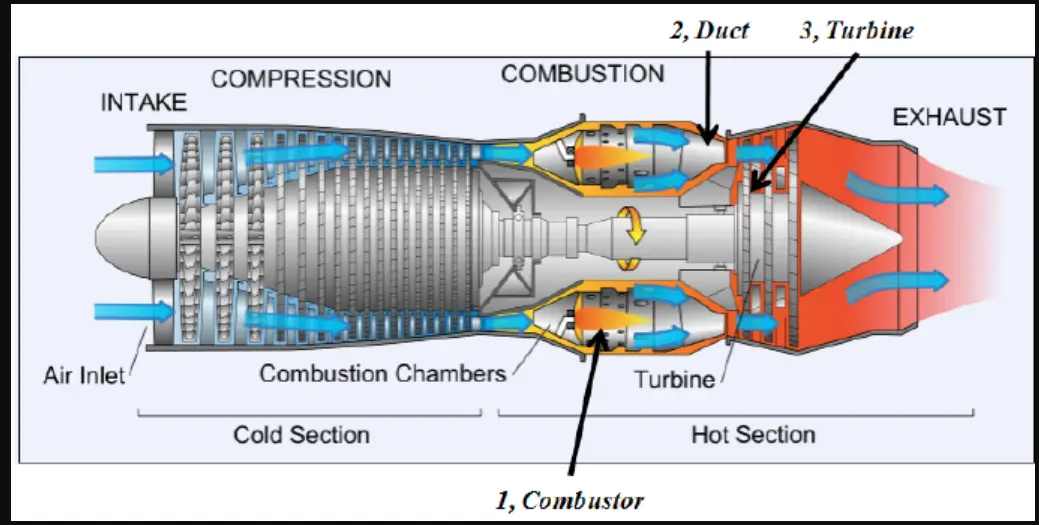
Note. From "Illustration of complex turbojet engine where we identify the focus areas for simplified [analysis]" by ResearchGate, n.d. (Source: https://www.researchgate.net/figure/Illustration-of-complex-turbojet-engine-where-we-identify-the-focus-areas-for-simplified_fig1_285576733).
Figure 1 shows the internal layout of a turbojet engine consisting of four basic parts, namely the intake, the compressor, the combustion chamber and the turbine and exhaust nozzle, which provide the engine thrust. The turbojet engine is the original type of jet engine. Both Whittle and von Ohain utilized this engine design during the 1930s and 1940s. All the air entering a turbojet engine passes through the compressor, combustion chamber, turbine and exhaust nozzle - the only source of propulsion for such engines. Turbojet engines are very simple in their design, but are able to reach very high speeds. Thus, turbojet engines were some of the most popular engine types for military airplanes (Hoeveler, 2024). This engine design allowed aircraft to reach unprecedented speeds. However, the drawback to this design is that it does consume a significant amount of fuel and creates a significant amount of noise. For these reasons, turbojet engines were not suited for commercial flights.
However, turbojet engines also have some significant disadvantages in their design. Turbojet engines are among the noisiest aircraft engines and burn a significant amount of fuel, especially at the speeds at which airliners cruise (around Mach 0.8). Each of these factors makes turbojet engines very rare in modern aircraft. They can be found in some military aircraft and high-speed research vehicles. However, most military jets employ low-bypass turbofan engines for greater fuel efficiency. These limitations on turbojet engines naturally led to the development of more efficient and quieter turbojets. There have been significant effects on the field of aviation technology due to the engineering research that was conducted to develop these enhanced turbojets.
Despite these weaknesses, however, the turbojet engine became an important part of aviation history. As the first practical jet engine, it demonstrated that jet propulsion was possible. Every type of jet engine created after the turbojet made use of the same fundamental concepts created by turbojet engineers. The turbojet engine, therefore, truly changed the course of aviation history - it opened up the door to the jet age. Furthermore, its development truly was a turning point in aviation technology. It would inspire other engineers to further research improvements to these designs and performance capabilities.
Turbofan Engines
Figure 2
Diagram of a Turbofan Engine
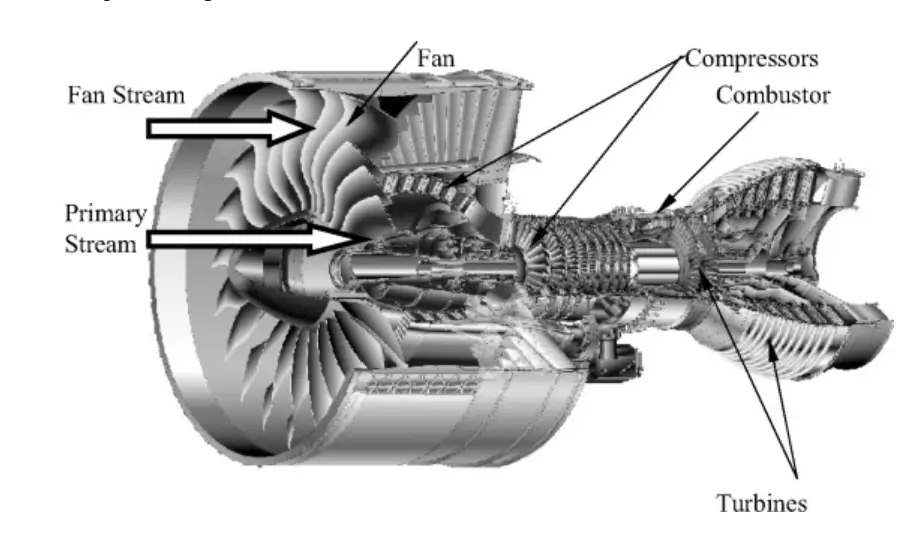
Note. Turbofan engines. (n.d.). Retrieved from "Turbofan engines" by ScienceDirect Topics. Reprinted with permission. (Source: https://www.sciencedirect.com/topics/engineering/turbofan-engines
Figure 2 shows the different components of the turbofan engine, including the large fan on the front of the engine and the exhaust sections that produce the thrust of the engine. The turbofan engine is the most common form of jet engine in use today. Turbofans can be found on almost all commercial airliners and many military aircraft. Turbofan engines are essentially turbojets that have a large fan added to the front of the engine. This fan moves a large amount of air around the outside of the engine, known as "bypass air". Both the bypass air and the air exiting the exhaust of the turbofan engine contribute to thrust; however, the bypass air is vastly more efficient than the turbojet's exhaust in creating such thrust.
The turbofan engine is described through its bypass ratio - the measure of how much bypass air exists relative to the core air within the engine (Turbofan Engine, 2026). High bypass turbofans employ a large fan to move a great amount of air around the engine. These engines are both fuel-efficient and less noisy than turbojets, making them ideal for airliners. Low bypass turbofans employ somewhat smaller fans that move less air than these high bypass engines. Such engines are typically deployed in military jets, which require high speeds.
The era of turbofan engine dominance spanned the 1960s and '70s. Today, almost all airliners in the world operate either on a CFM56, a GE90 or a Rolls-Royce Trent engine. All of these are turbofan engines that offer many thousands of pounds of thrust yet operate relatively quietly and economically (Turbofan Engine, 2026). Further research in this area of engine manufacturing is one of the most important ways to make air transportation affordable and available for ordinary people. There is less consumption of fuel from turbofan engines compared to other types of jet engines (Turbofan Engine, 2026). It reduces the cost spent by the airlines in order to fuel their planes and, at the same time, increases the range of comfortable travel for the planes' passengers.
Turboprop Engines
Figure 3
Diagram of a Turboprop Engine
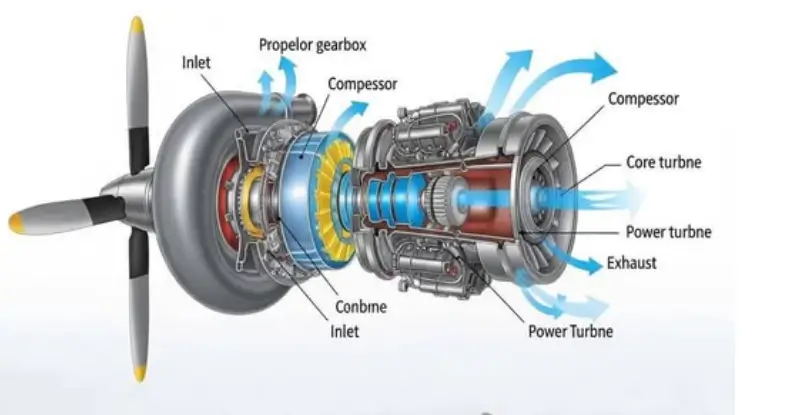
Note: From "How a turboprop engine works" by Anika Insana, 2024 (Source: https://www.facebook.com/Anika.Insana/posts/751244070855462). Reprinted for educational purposes.
Figure 3 shows the various parts of a turboprop engine, which are the propeller at the front and the reduction gear, which connects the gas turbine engine to the propeller. A turboprop engine uses a gas turbine to power a propeller - it does not do so to create thrust through its exhaust gases (Atr-aircraft, 2025). The gas turbine actually draws almost all of its energy from those same exhaust gases to turn a shaft connected to the propeller through a gearbox. While some thrust is made this way, most comes from the propeller. Each of these engines is more efficient at lower speeds and altitudes, hence turboprop airplanes tend towards either short-haul flights or cargo planes.
Turboprop engines can be found in regional airliners, cargo planes and even agricultural planes. Airlines such as ATR 72 and Bombardier Dash 8 aircraft use these engines to transport their passengers over shorter flights without the speed of a jet airplane. These engines are highly reliable and capable of taking off and landing upon short and unpaved runways, perfect for areas of the world with limited airport infrastructure (Atr-aircraft, 2025).
However, the turboprop engine has both advantages and disadvantages relative to the turbofan engine. The very nature of the propeller makes the turboprop engine more fuel efficient at lower speeds. The downside is that a turboprop engine cannot reach high speeds (Atr-aircraft, 2025). Propellers are less efficient at speeds over 450 mph - making the turboprop engine inappropriate for aircraft that must reach such speeds. For the right mission type, however, turboprop engines present an excellent solution to the problem of traveling short distances at a moderate speed while minimizing fuel cost.
Turboshaft Engines
Figure 4
Diagram of a Turboshaft Engine
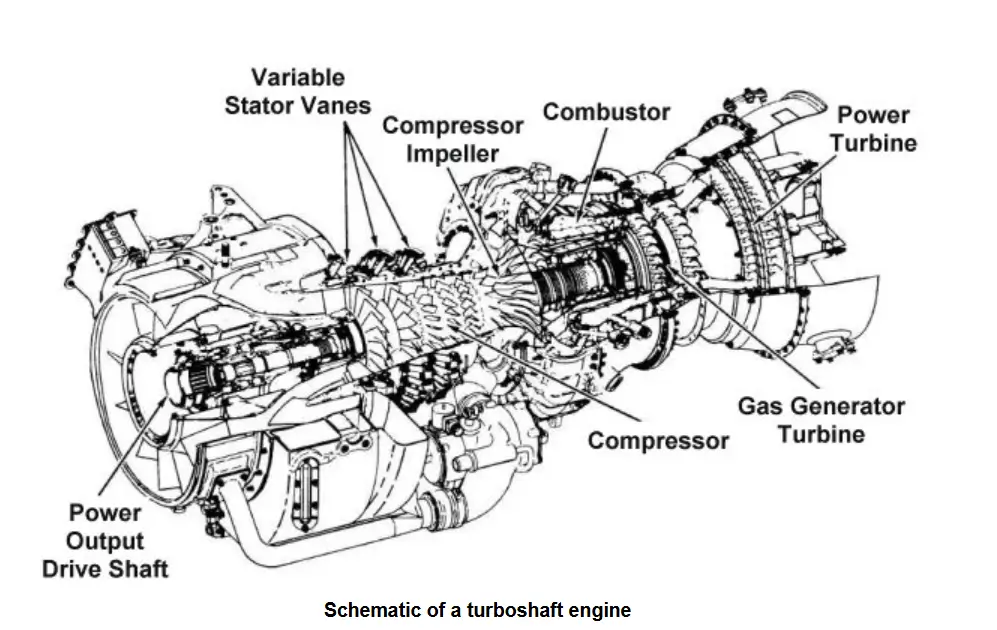
Figure 4 depicts the main components of a turboshaft engine and how the turbine helps produce mechanical power via the engine’s output shaft. The turboshaft engine is also related to the turboprop engine. Rather than utilizing a propeller to distribute the engine’s power, the turboshaft engine is often used to power other forms of machinery (Aygun, 2024). They are most commonly utilized in helicopters to power the aircraft's main rotor blades. Unlike other forms of gas turbine engines, the purpose of a turboshaft engine is to produce mechanical power rather than thrust. The engines do not expel much exhaust gas to generate the thrust for the aircraft to move.
Beyond helicopters, these types of engines are also deployed into non-aviation equipment, such as ships, tanks, trains and generators. The same types of turboshaft engines that help to power military helicopters can be utilized to power the generator that will produce electricity for the power plant. Such uses of this type of engine make the turboshaft engine one of the most widely used forms of gas turbine engine - manufactured by companies like General Electric, Pratt and Whitney and Rolls-Royce.
In helicopter applications, the turboshaft engine is connected to the main and tail rotors via a transmission system (Aygun, 2024). The engine operates at a high and constant speed. At the same time, the transmission system allows the helicopter to control how much of the engine power is provided to each of the helicopter’s rotors. Given that the main rotor provides both lift and directional control for the aircraft, the turboshaft engine must deliver smooth and consistent power to that main rotor. All modern turboshaft engines are extremely reliable and can produce thousands of shaft horsepower within a compact and lightweight package.
Conclusion
The gas turbine engine represents perhaps the most important development in aviation or engineering history. From the aeolipile of Hero of Alexandria to the development of jet engines by Frank Whittle and Hans von Ohain, the evolution of turbine technology has been gradual yet massively impactful. The history of advances shows the slow development of scientific ideas into technological advances. The gas turbine is one of many technologies emerging from the discoveries of centuries past. Such turbines are vital components of both aviation and industry today.
The operation of gas turbine engines rests upon physical science concepts, Newton’s laws of motion, Bernoulli’s principle and conservation of energy. These physical science laws help explain the engine's function, especially across its four main types. Gas turbines have been crucial technological elements throughout the years. Regardless of the advancements made within areas such as transport and aviation or energy generation, gas turbines have a critical role. Furthermore, it is also clear due to such continued development that these remain a critical technology of the years to come.
References
- APG. (2024, July 12). History of Steam Turbines: A Look at Steam Engine Power | Allied Power Group. Allied Power Group. https://alliedpg.com/latest-articles/history-of-steam-turbines/
- Atr-aircraft. (2025, November 18). Turboprop: engines, aircraft, and market trends | ATR aircraft. ATR. https://www.atr-aircraft.com/turboprop/
- Aygun, H. (2024). Effects of air-to-fuel ratio on parameters of combustor used for gas turbine engines: Applications of turbojet, turbofan, turboprop and turboshaft. Energy, 305, 132346. https://doi.org/10.1016/j.energy.2024.132346
- Bajpai, P. (2018). Bernoulli Principle - an overview | ScienceDirect Topics. Www.sciencedirect.com. https://www.sciencedirect.com/topics/engineering/bernoulli-principle
- Britannica. (n.d.). Gas-turbine engine - Development, Efficiency, Power | Britannica. Www.britannica.com. https://www.britannica.com/technology/gas-turbine-engine/Development-of-gas-turbines#ref134516
- Dr. Iyad Al-Attar. (2020, December 23). Gas Turbines: A Journey Through Time. Achrnews.com; ACHR News. https://www.achrnews.com/articles/161191-gas-turbines-a-journey-through-time
- Eckardt, D. (2023). Jet Web: CONNECTIONS in the Development History of Turbojet Engines 1920-1950. Springer Nature. https://books.google.co.ke/books?id=MeirEAAAQBAJ
- GE Aerospace. (2018, April 12). Fight or flight: The startling start of Whittle’s first jet engine | GE Aerospace News. Www.geaerospace.com. https://www.geaerospace.com/news/articles/100-year-anniversary-technology/fight-or-flight-startling-start-whittles-first-jet-engine
- Giampaolo, T. (2020). Gas turbine handbook: principles and practice. River Publishers. https://www.amazon.com/Gas-Turbine-Handbook-Principles-Practice/dp/1482228882
- Guide, A. (2025, August 24). History of Turbine Engine Development. Aircraft Systems; Blogger. https://www.aircraftsystemstech.com/2025/08/history-of-turbine-engine-development.html
- Hoeveler, P. (2024). How does a turbojet engine work? MTU AEROREPORT. https://aeroreport.de/en/good-to-know/how-does-a-turbojet-engine-work
- Hughes, J. Donald. (2023). Hero of Alexandria | Research Starters | EBSCO Research. EBSCO. https://www.ebsco.com/research-starters/biography/hero-alexandria
- Magazine, S. (n.d.). The World’s First Combat Jet. Smithsonian Magazine. https://www.smithsonianmag.com/air-space-magazine/the-worlds-first-combat-jet-78/
- Mevissen, F., Krewinkel, R., & Wiedermann, A. (2025). The Future of Industrial Gas Turbines: Technological Advances and Market Trends. Journal of Thermal Science and Engineering Applications, 18(3). https://doi.org/10.1115/1.4070223
- Newman, J. (2008). Newton’s Laws of Motion for a Particle Moving in One Dimension. Springer EBooks, 1–28. https://doi.org/10.1007/978-0-387-77259-2_2
- Pan. (2025). JTT & the Jet Age/1. Panam.org. https://www.panam.org/juan-trippe/jtt-the-jet-age-b-707s
- Patel, S. (2019, July 30). The POWER Interview: What Drove the Gas Turbine Technology Leap at GE Over the Past 70 Years. POWER Magazine. https://www.powermag.com/the-power-interview-what-drove-the-gas-turbine-technology-leap-at-ge-over-the-past-70-years/
- R Martinez-Val, & Perez, E. (2009). Aeronautics and astronautics: Recent progress and future trends. Proceedings of the Institution of Mechanical Engineers. Part C, Journal of Mechanical Engineering Science, 223(12), 2767–2820. https://doi.org/10.1243/09544062jmes1546
- Rochem Fyrewash. (2024). The History of the Gas Turbine. Rochem Fyrewash. https://www.rochem-fyrewash.com/en-us/news/the-history-of-the-gas-turbine/
- St John’s College Access. (2021, March 1). Inspire Digital: The Evolution of Gas Turbines. St John’s Inspire Programme. https://sjcinspire.com/2021/03/01/the-evolution-of-gas-turbines/
- Turbofan Engine. (2026). Nasa.gov. https://www.grc.nasa.gov/www/k-12/VirtualAero/BottleRocket/airplane/aturbf.html
- Walter James Boyne, & Bilstein, R. E. (2018). History of flight - The jet age. In Encyclopædia Britannica. https://www.britannica.com/technology/history-of-flight/The-jet-age
-
Other services: