Most students know that they need to write a thesis statement as part of most essays, even though it’s never written in the assignment guidelines. It’s an unspoken rule of college-level writing and is one of the main things a professor will look at to determine whether an essay is strong or not. You may know that you need to write a thesis, but have no guidance about what makes one work and what makes one vague. This guide covers a plain and useful definition of a thesis statement, 5 rules that will make your thesis statement strong, and a formula to reuse again and again with examples.
What Is a Thesis Statement?
A thesis statement is usually one, but sometimes two sentences that sit at the end of the introduction, stating the main claim of the essay and how it will be supported. This is the most important statement in your essay, making it clear to the reader what they will be gaining from reading your essay. It’s the thing your professor, a tutor, or any reviewer will look for first to make sure you have a clear direction for the writing. Of all the parts of an essay, the thesis is the foundation that every other piece stands on and relates to.
A thesis is not:
- Your Topic: your topic is the general subject that your essay covers, while the thesis is a specific claim you’re making about that topic.
- A Well-Known Fact: the thesis is a claim that your reader should be convinced of or understand in more detail by the end of your essay. If it’s a fact, there’s nothing to argue, convince, or explain in depth.
- An Announcement: your thesis should be a clear statement of what the essay covers, instead of a preview of what you will discuss.
Knowing what a thesis is and is not is step one, but writing a good one is step two.
What Makes a Thesis Statement Strong? (+ 5 rules of a thesis statement)
A strong thesis doesn’t use fancy vocabulary or eloquent language. Instead, it lays a clear pathway for the rest of the essay to follow, where every paragraph answers the claim made in the thesis statement. In turn, the conclusion should provide a succinct answer to the thesis statement to show that your argument is complete. With that in mind, there are 5 main rules of a thesis statement that you can use to test its strength.
- It makes a debatable claim. Can someone write an essay on the opposite end of the argument?
- It’s specific. A specific thesis makes a focused argument using precise terms. Can any of the words in your thesis be replaced with more specific ones?
- It has one main idea. Your thesis should be one main point that’s specific enough that you can fully cover it in the assigned length. Can you prove it in 5 pages?
- It previews your reasoning. The thesis previews the main ideas you’ll use to support the main claim. Can you outline the paragraphs using the thesis statement alone?
- It fully answers the prompt. Your thesis should directly answer the question your assignment asks. If it doesn’t, it should be rewritten. Does your thesis answer a related question to the thesis, or answer it directly?
Don’t worry too much about having this all together before you start writing. You can always change the thesis as your argument develops.
The Thesis Statement Formula
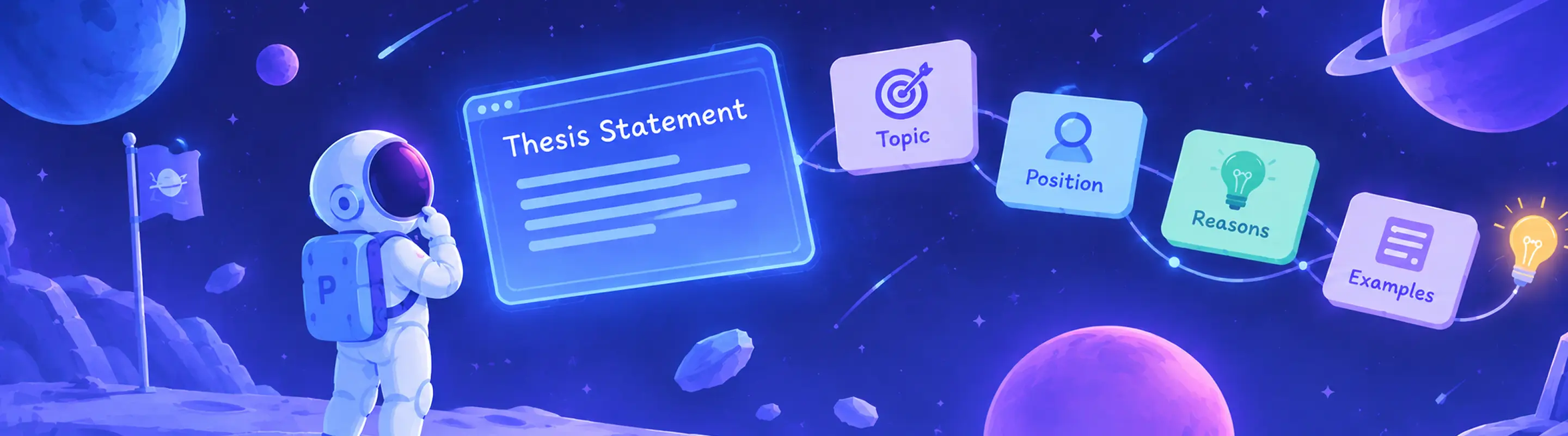
Your thesis covers three main parts:
-
Topic: The specific subject that you’re making a claim about.
Tip: narrow down your topic from the main subject you’re covering. Instead of academics, you might choose “student teacher relationships”
-
Claim: Your position or main claim about the topic.
Think about the main thing you’d want the reader to understand about your position on it. “The student-teacher relationship is one of the most important ways to increase academic resilience in students.”
-
Reasons: This answers the “how do you know?” portion of the claim with two or three points that help the reader understand how you will support your claim.
Due to the aspects of emotional closeness, locus of support, and positive encouragement.
The Fill-In Template
A simple formula you could follow to create the thesis statement is:
[Topic] [claim] because [reason 1], [reason 2], [reason 3].
“[The student-teacher relationship] [is one of the most important ways to increase academic resilience in students] because of [emotional closeness, locus of support, and positive encouragement.]”
Once you have the working parts of the thesis statement written down, you can change the structure of the sentence to flow and sound more natural in your voice.
“The student-teacher relationship is one of the most important ways to increase academic resilience in students, due to the emotional closeness, locus of support, and positive encouragement that the teacher provides, and their role in improving responses to adversity.”
Thesis Sentence Starters
- Although [opposing view], [claim] because….
- [Topic] is [claim], as evidenced by….
- By implementing [claim], [positive result] because of….
- The main cause of [issue] is [claim], rather than [common assumption] due to…
Weak vs Strong: 12 Thesis Statement Examples
-
Social Media
Weak: Social media negatively affects teenagers
Strong: Despite its prevalence, regular use of social media apps decreases the positive self-concept of teenagers by encouraging a constant search for peer approval, feedback, and comparison.
-
School Uniforms
Weak: School uniforms do not help students learn.
Strong: Public schools' use of mandatory uniforms restricts the self-expression and autonomy of students without improving behavior, showing little justification for their use.
-
Book Appraisal
Weak: Ill Will is a good book.
Strong: The author of Ill Will utilizes multiple perspectives to convey that death affects the psyche in different ways, detailing the various coping mechanisms that people use to process grief.
-
Climate Change
Weak: Climate change has negative effects on the environment.
Strong: Local governments should prioritize infrastructure enhancements due to the flood damage, increased rainfall, and power surges that have been caused by climate change.
-
Video Games
Weak: Video games are violent and kids shouldn’t play them.
Strong: While many believe that video games cause aggression, research has shown that violent video games have negative effects on parental attachment and peer interactions.
-
Remote Work
Weak: Remote work has changed attitudes toward work in recent years.
Strong: While remote work has demonstrated positive influences on employee retention, its negative effects persist in the areas of employee onboarding and mentorship.
-
Fast Food
Weak: Fast food is not healthy and should not be encouraged.
Strong: The introduction and promotion of cooking classes in high school has been shown to decrease reliance on fast food as a weekly meal plan among college-aged students.
-
Artificial Intelligence
Weak: Does AI help high school students?
Strong: While AI writing tools assist students with brainstorming and outlining, they have shown a notable influence on the ability to retain information and present compelling arguments when using them for drafting.
-
Recycling
Weak: Recycling is important and should be discussed more in public schools.
Strong: In-depth education on recycling in public schools increases responsible usage through the use of sorted bins and proper preparation of recycled materials.
-
Homework
Weak: While there are positives to homework, the negatives outweigh them.
Strong: While short, drilled assignments have shown to benefit commitment to long-term memory, longer homework assignments show reduced academic benefits while negatively affecting quality of sleep and information retention.
-
Play Review
Weak: Shakespeare wrote many successful plays.
Strong: Shakespeare’s demonstration of Lady Macbeth’s collapse shows that anyone who possesses ambition without moral conscience creates destruction within the person who holds it.
-
College Affordability
Weak: College is too expensive and must be more accessible to incoming freshmen.
Strong: Government systems should prioritize college affordability through interest-free loans, providing accessibility to college students while reducing lifetime debt.
Thesis Statements by Essay Type
| Essay type | What the thesis must do | Example opening |
| Argumentative | Take a side that someone could oppose | "Schools should… because…" |
| Persuasive | Convince the reader to take an action or adopt a belief | “Students should..because…” |
| Expository | Explain how or why something works without taking a side | “The main function of [topic] is…” |
| Analytical | Interpret the meaning or technique of a text or idea | “The author uses … to demonstrate…” |
| Narrative | Describe a story with a significant lesson or changing moment | “[Experience] taught me that…” |
| Evaluation | State the central finding or position that the evidence supports | “The evidence suggests that….” |
Where It Goes, How Long It Is, and the Rules Students Ask About
Where does a thesis statement go?
The thesis statement goes at the end of the introduction, and it’s usually the last sentence. If you’re learning how to write an introduction for an essay, think of it as the final, culminating statement on the back of your hook and background.
How long should a thesis statement be?
It is usually about a sentence, or 20-40 words. This can change depending on the length of your essay. For example, a 1,000-word essay might need a more specific, shorter thesis statement.
Can a thesis statement be two sentences?
Yes, especially for longer or more complex essays, your thesis might stretch to two sentences, where the first sentence is the main claim and the second covers the reason for your claim.
Does a thesis statement have to be one sentence?
While one sentence is the default that teachers may expect, focus on why you’re lengthening it past one sentence rather than a general rule.
Can a thesis statement be a question?
No. The thesis is the answer to a question rather than a question. It is a firm statement that states a position.
Can you use "I" in a thesis?
While there’s no rule against using “I,” it depends on the type of essay and instructor. While it is generally fine in narrative or personal essays, consider the reasoning for using it in argumentative or analytical papers.
Frequently Asked Questions
What is a thesis statement example? “The student-teacher relationship is one of the most important ways to increase academic resilience in students, due to the emotional closeness, locus of support, and positive encouragement that the teacher provides and their role in improving responses to adversity.”
What is the thesis in an essay? The thesis is the last 1-2 sentences of the introduction that provide the central claim that the essay is based upon.
What are the 5 rules of a thesis statement? The thesis should be debatable, specific, focus on one main idea, preview reasoning, and fully answer the prompt.
Should I use a thesis statement generator? While a generator can help you brainstorm thesis statement ideas, it won’t reflect the evidence you have or your unique perspective. You can use a generator as a starting point, but always refine it into your own words. Additionally, many schools have strict AI use policies, so always check the guidelines before you use any type of generators. You’re the essay writer, so your point of view is what matters.
Get Started with a Bold Claim
Even though a thesis statement may feel intimidating, it truly is simple: a clear sentence about what you think, and why you’re right about it. Just remember to make it debatable, specific, and focused. If your thesis accomplishes these things, you’ve made an excellent start. To get started, gather your evidence, think about your position, and write down a draft thesis statement. Compare it against the five rules, and if all else fails, use the formula to flesh out a solid starting point. Remember that as you write your draft, you can always revise the thesis statement to better reflect the argument you’re making as you write; nothing is set in stone. But if you start with a solid thesis statement, the rest of the essay has a solid pathway for you to follow to the end.