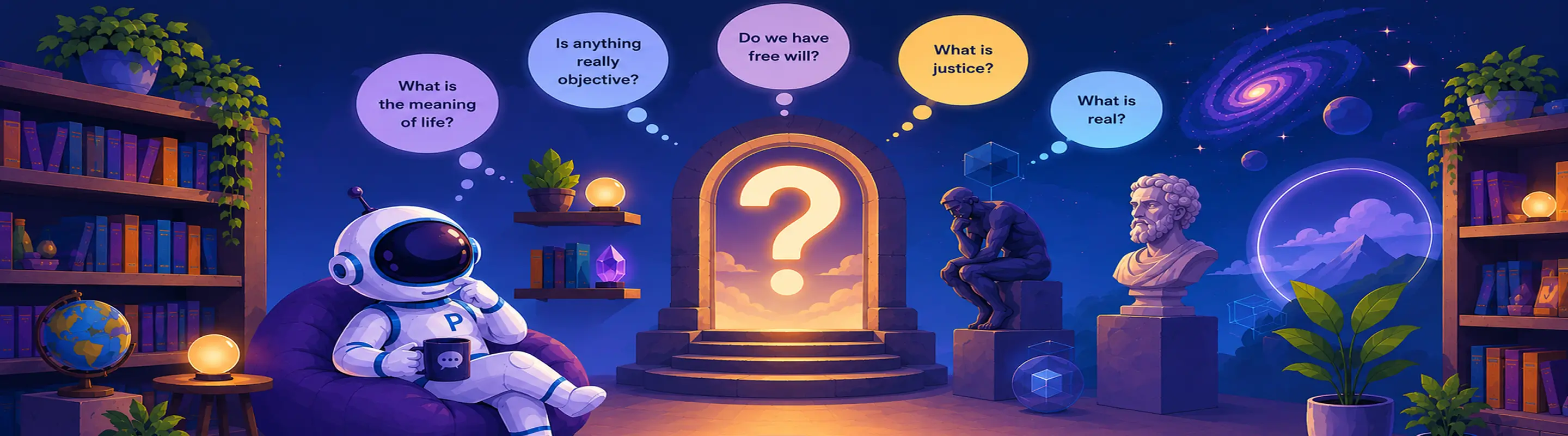
You just received an assignment that requires you to discuss a philosophical question, and you have no idea where to start. This is a common experience, especially for college students who are battling with big life questions, from things like wondering why your classes will actually help you in real life, to what's the point of anything? Debate topics are huge in university settings, requiring you to engage with philosophy even if you've never taken a class in it. Add paper writing into the mix and you're completely lost with no idea where to start. In these situations, the best thing you can do is know where to start, so you can capture your true voice and gain clarity on why philosophical questions matter. That's why we've put together a list of topics that can guide an in-depth philosophical essay and help you understand the goal of these types of assignments.
What Makes a Question Philosophical?
On a typical test in a math or science class, you've been able to review your flashcards or your notes to answer the questions correctly. But philosophy doesn't work like this, which is why it can be hard for college students to grasp. A philosophical question can't be solved by looking it up on Google or performing an experiment to find the answer. Unlike scientific questions, philosophical questions bring up concepts like meaning, values, and assumptions that may change from person to person. Because of this, philosophical questions never end with a specific answer. Instead, they stimulate conversations that reveal differences between thought processes and invite people to acquaint themselves with new perspectives. So, when it comes to writing about philosophy, you don't need to solve the questions, but demonstrate a clear thought process about them. That's why starting with a solid question is extremely important, maybe even more important than a typical science or math assignment.
What Are Abstract Philosophical Questions?
Abstract philosophical questions deal with ideas instead of things that are observable; things like time, identity, and justice. It's the most common denominator across philosophy questions, and it's the main concept that drives the notion that these questions don't come with concrete answers. Instead of asking something like "how much time would it take to walk across the United States," philosophy asks, "why do we measure things in time?" One question has a simple answer; the other does not. There are different types of abstract philosophical questions, and we've given you some examples below.
Metaphysics: Questions About What Exists
Metaphysics asks questions about the nature of reality. More simply, how we determine existence, or whether existence is even real.
- What determines existence?
- Does a moment in time require memory to exist?
- Is randomness, in itself, a deterministic pattern?
- What are the observable markers of consciousness?
- Does absolute truth exist?
- Is there a difference between existence and reality?
- At what point does public belief become reality?
- Do events require a cause?
- Is space an organizational construct or an observable reality?
- Does time pass if there's no one to observe it?
Epistemology: Questions About What You Can Know
Epistemology asks questions relating to how we know what we know. Thinkers may question what counts as knowing something and how we can justify the things that we believe.
- How can you tell the difference between dreams and reality?
- Are senses always accurate?
- Is it possible to know anything with 100% certainty?
- What's the true difference between knowledge and opinion?
- How can anything be proven if experimentation always has limitations?
- Is reason or experience more indicative of truth?
- How does technology influence primitive knowledge?
- Is there such a thing as an original thought?
- Can two people disagree and both be right?
- Are your experiences true if they aren't shared?
Ethics: Questions About Right and Wrong
Ethical philosophy asks how people should behave in society and what makes people or actions good or bad.
- Is dishonesty ever permissible?
- Is morality dependent on culture?
- Does moral obligation only extend to people we know?
- Is it acceptable to break laws if there are no consequences?
- Are legality and ethics synonymous?
- What makes a bad person?
- Do intentions or actions matter more when judging ethics?
- How can we judge past behavior with current standards?
- Can ethics change with a rapid paradigm shift?
- Is it possible for crime to be rooted in morality?
Philosophy of Mind: Consciousness, Identity and Free Will
This type of philosophy questions what our minds are made up of, what gives people their identity, and whether we can truly have full autonomy over our choices.
- Do mind and body exist separately?
- Does consciousness require humanity?
- Does identity remain constant across time?
- Is identity determined by memory?
- Are any of our choices truly our own?
- Is identity fully replicable?
- What determines sense of self?
- What's the difference between awareness and consciousness?
- Is personality determined by thoughts or actions?
- Can anyone's experience be truly identical?
Political Philosophy: Power, Justice and Freedom
Political philosophy covers questions about power and how it should be distributed, how fairness is judged and implemented, and how we can achieve true freedom.
- What determines if a law is just?
- Is true equality possible?
- Should personal freedom be sacrificed to benefit the group?
- Should decision-making be determined by access to information?
- Does true freedom exist?
- Does true democracy exist, or can it?
- What are the moral obligations of a given society?
- Is equity more beneficial than equality?
- Is full justice achievable?
- Is the government responsible for ensuring fairness?
Existential Questions: Meaning, Death and Purpose
Existential philosophy is one of the most difficult to discuss, as it deals with big picture ideas like why we exist, whether life is meaningful at all, or what the point of living is. This is a popular one for college students, despite its difficulty.
- Does living require a higher purpose?
- What's the meaning of living if death is inevitable?
- Does morality create meaning?
- What is the true goal of life?
- Does a life have meaning if no one remembers it?
- Does productive societal functioning contribute to a meaningful existence?
- Is freedom of choice truly free?
- How does the uncertainty of death contribute to the way we live?
- Is meaning found or created?
- Does meaning determine daily living?
Unanswerable and Funny Philosophical Questions
- Is something or nothing more meaningful?
- Does perception determine sound?
- Is true infinity real?
- How much is identity tied to physical appearance?
- Is cereal soup?
- Is true nothingness actually possible?
- Why are breakfast and dessert so similar?
- Does the future become the present once we're aware of it?
- How is true happiness measured?
- What's the difference between love and infatuation?
How to Turn a Philosophical Question Into an Essay
Now that you have some questions to choose from, spanning from serious to funny debate topics, the next logical step in preparing for an essay is to follow a solid structure that includes some key points.
- Pick a question that makes you uncomfortable: The question that you choose for your essay should be one that genuinely creates a reaction within you. Genuine curiosity and eagerness to respond to a question create more authentic and passionate writing.
- Find your specific angle: These questions are large-scale concepts, so if possible, take a question and make it even more specific. This is where your personal experiences or expertise can come in.
- Take a position: Instead of describing both sides of the issue, your essay will have more impact if you take a certain position on the topic. Start off your essay with a certain position in mind, and if it changes as you research and write, that's fine too.
- Use real-life examples: Philosophy is designed to get us thinking about our own thought processes, values, and experiences, so connecting concepts to real-life situations will help create clarity in your writing while also fully answering the prompt.
- Address counterarguments: This may sound like explaining both sides, but the goal here is to capture a debate rather than an explanation. Even though you have a specific position, the strongest opposing view should be acknowledged to show that you understand the concept from multiple angles. Utilize counterarguments to create fully fledged argument points for your position. Don't just introduce a counterargument; respond to it.
Frequently Asked Questions
a. What are the top 10 philosophical questions?
- Does anything exist outside of the human conception?
- How is consciousness determined?
- How do we know if we're dreaming or not, and what's the true difference between dreams and reality?
- Are any of our choices truly our own?
- Is identity determined by memory?
- Can crime be justified if it creates an ethical result?
- Are morals determined by culture?
- Should freedom be sacrificed to benefit the group, and if so, how much?
- Is meaning created or found?
- Does nothing truly exist?
b. What is an example of a philosophy question?
A philosophy question is anything without a definitive answer; something that can't be determined definitively through logic or experimentation.
Example: What establishes morality?
c. What are some good existential questions?
Existential questions come from the operant word "exist." A good existential question covers our existence and the reason for it.
- Does life have meaning without social relationships?
- Are established societies required to create meaningful lives?
- What's the goal of life if death is inevitable?
- Is leaving a legacy a facet of life or a response to death anxiety?
d. What's a funny philosophical question?
Think of casual interactions with friends where you never came to a clear answer, but it was still a fun conversation.
- Can all foods be sorted into four basic categories?
- Do all animals go to heaven, or just certain types?
- Is a hot dog a sandwich?
Turning a Late Night Spiral Into a Victory
Many of these concepts might leave you spiraling in the middle of the night, contemplating life's biggest questions without any hope of a real answer. This is completely normal, and actually good for your brain. Even though they can be mentally exhausting, take these moments as opportunities to practice philosophical thinking in action, challenging your own ability to think broadly and deeply. College is all about moving from remembering information to thinking for yourself. You don't need formal training to think philosophically, but you do need curiosity, openness, and the ability to sit with questions that you may never get the answers to. From here, look at our other articles on writing essays that'll help you formulate your thoughts to create a solid and well-rounded paper. It's a challenge, but it will be rewarding.