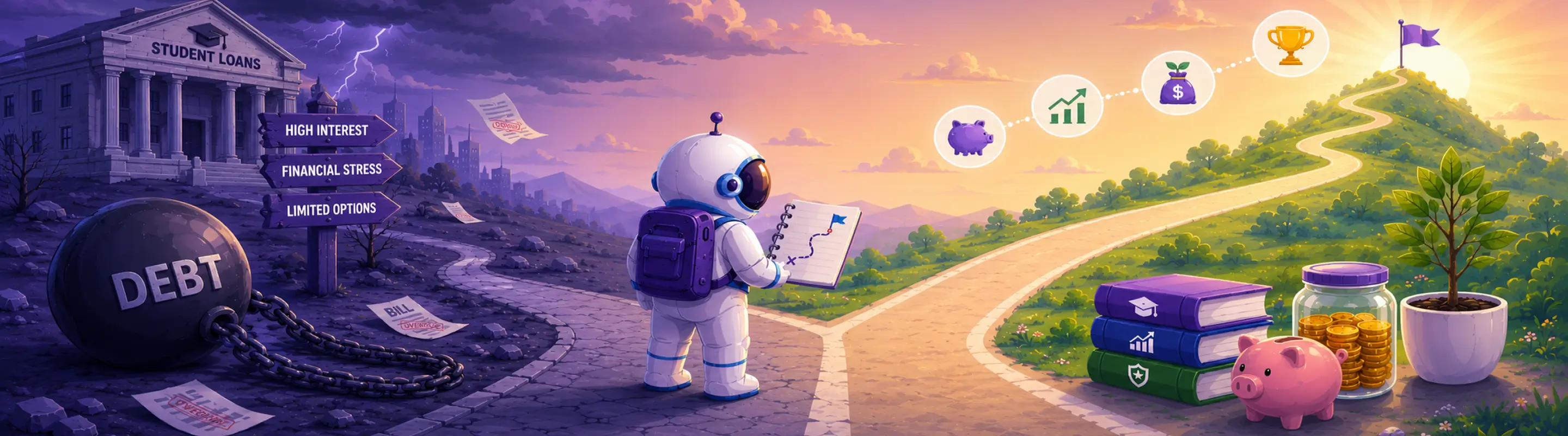
How will avoiding student loans help set the tone for not taking on debt for the rest of your life? This is a real question that comes from personal finance coursework, specifically Dave Ramsey’s Foundations curriculum. It’s a big question, but it’s an extremely important one to answer for incoming college students. The short answer is that avoiding student loans forces you to build good budgeting skills, delay gratification, and develop problem-solving habits that teach you how to handle money before you ever get your first real paycheck.
The average student loan debt is about $38k for every student that borrows, totaling over 1.7 trillion dollars in student debt in the United States. College shouldn’t ruin your life; it should set you up for success, debt-free. Borrowing should never be your default financial decision, but it’s easier said than done. That’s why it’s important to learn the psychology, math, and practical ways to pay for college without student loans.
Why Your First Big Money Decision Sets the Pattern for Life
Your first big financial decision, how to pay for your college coursework, becomes a template that you will use for every big financial decision that follows, like buying a car, using credit cards, or opening mortgages. Multiple aspects go into these decisions, but the main ones are habit formation, financial confidence, and your mindset.
Paying cash for things trains you to save first and spend later, but borrowing creates money habits that normalize monthly payments. It’s brain chemistry. Your prefrontal cortex does the effort first, and the basal ganglia makes it an automatic behavior. That first financial decision commits your spending habits to memory, making it harder to change them later.
Instead, solving the tuition problem without loans builds financial independence and confidence, making it easier for you to tackle other problems without taking on debt. It proves that if a big expense comes up, your default won’t be to borrow and worry about it later; it’ll be to tackle the problem head-on, independently. As these habits grow, and your confidence rises, you develop a money mindset where you ask yourself how to afford the things you need, instead of reducing it to a monthly payment.
What Student Debt Really Costs: The Math Nobody Shows You
Interest and Compound Interest, In Real Numbers
Using the average borrowing amount, 38,000 dollars, the average 6.5% interest rate, and a standard 10-year plan, the hidden costs of student loans add up fast. Maybe you’re paying 430 dollars a month, but by the end, you spend $52,000, $14,000 in interest. That’s an extra bill you’re paying just from the decision to borrow money instead of paying for college yourself.
The Opportunity Cost
Opportunity cost is the value of the thing you didn’t choose. Think about this in terms of student loans. That same $430 every month that’s spent on student loans could be invested at 22 years old, and earn 8% interest, making you $79,000 by the time you’re 32. This means that the opportunity cost of using student loans is about 80k, which is the real price you pay for starting life in debt, on top of financial stress.
Debt-To-Income Ratio, Credit Score, and Your Future
Debt-to-income ratio (DTI), or the amount of your monthly income that goes towards debt, is the same number that lenders use to determine whether you’re a good fit for borrowing money in the future. Mortgage lenders usually want your DTI to be below 43%, and if you’re a college student who doesn’t have a full-time job, that number will be extremely high. Not to mention, missed payments damage your credit score, another number used to determine your worthiness for mortgages or rentals, things that require lenders to trust you. Student loans can be a big roadblock to your future, which is important to consider. But that’s not the only thing to consider.
How Debt Becomes a Lifestyle: The Psychology of the Payment Trap
Taking out a student loan may feel like an isolated decision, but psychology tells us differently. Once taking out one loan feels normal, all the other ones will feel normal too, making a type of “payment creep” that takes over your life, drowning you in credit card balances and financial stress.
The credit industry benefits from this, using marketing tactics designed to appeal to your psychology with teaser rates, minimum payments, and pitches about building your credit, but as interest rates rise, your candidacy for debt-free living falls.
But maybe you tell yourself, “This degree will benefit me, this is good debt,” but even good debt has risks. Getting your degree won’t guarantee an income level high enough to pay off your debts; it actually doesn’t guarantee income at all. And as you normalize your spending habits, you add on depreciating assets, like cars, that lose value over time.
Research supports this. People who graduate without debt actually report less financial stress and higher savings rates after college, and living debt-free contributes to an identity of prosperity and balance.
Are Student Loans Always a Bad Thing? An Honest Look
Debt isn’t 100% bad, and sometimes necessary. Debt is a tool, but it’s marketed as a first option. In fact, federal student loans can have benefits compared to private student debt, like low interest rates, income-driven repayment plans, and student loan forgiveness paths. In truth, a modest federal loan is the better choice compared to dropping out with private debt and no pathway to pay it off. If those are your options, take student loans.
So no, student loans are not always a bad thing, especially when the other option is private debt. If you must go into debt, take the student loan route, but keep total borrowing below your expected first salary, and only resort to it after you’ve exhausted free money or cheaper paths. Even if you do borrow, it’s important to do it consciously with a repayment plan in place. The true purpose of this article is to promote debt-averse habits, not to avoid debt altogether.
How to Pay for College Without Loans: 9 Ways That Actually Work
Max Out Free Money First: Scholarships and Grants
If you’re a junior in high school and you’re thinking about how to pay for college without loans, now is the time you can start applying for scholarships and grants. Start with local scholarships with less competition, even if the rewards are small. Some tools you can use for scholarships are sites like FastWeb, Scholarships.com, and BigFuture. Keep in mind that the scholarship applications often require essays, so if you’re not a writing expert, consult some essay writers to help you with them.
File the FAFSA Every Year
The Free Application for Federal Student Aid (FAFSA) is a program that provides need-based grants to college students. Even if you’re unsure if you qualify, you should fill it out every year to unlock work-study opportunities and state aid. Most students think that their parents earn too much to bother, but it’s better to fill it out anyway since there’s no risk involved.
Start at Community College
Every college student has to take gen ed credits, and taking them at a community college is a fraction of university tuition. Community college is around $4,000 compared to $11,000 for university, saving you $7k for one year alone. Since gen eds are largely the same, you can transfer them to the university of your choice and save a big chunk of change. Make sure that the credits you take transfer smoothly to your target university.
Choose an Affordable School on Purpose
If affordability is a concern for you, in-state public schools are almost always more affordable than out-of-state or private institutions. You may have a dream college, but debt-free college is a trade-off with lifelong benefits.
Consider Trade Schools and Apprenticeships
Skilled trades are a strong option for education that most competitors ignore. Trade schools and apprenticeships mean paid training, credentials in 1-2 years, and strong salaries.
Work While You Study
Many college students work while they study, part-time in the semester, and full-time during the summer. Federal work-study, working on campus, is also an option, as well as co-ops. Some employers even offer tuition assistance and reimbursement programs, so seeking employment during your school experience is one of the best ways to pay for college without loans.
Use College Savings, If Available
Some parents or relatives start a 529 plan, which is a savings account specifically for education costs. In this type of account, the money grows tax-free, as long as you spend the withdrawals on education. This is called tax-advantaged growth, so if your investments grow to $10,000, they stay at $10,000 once you take them out of the account. If your parents saved little or nothing for college, that’s completely fine. Most families can’t or haven’t saved for college, and that’s nothing to be ashamed about.
Build a Student Budget and Stick to It
One of the best things you can do for debt-free college is create a budget. A good rule to follow is the 50/20/30 rule, which breaks down your income into three main buckets: needs, wants, and savings. It’s simple and easy to follow, which makes it easier for you to stick to it. When tuition is coming out of your budget, fees and living costs dominate your needs bucket, which may be more like 70%, wants 10%, and instead of 20% going toward savings, it’s going towards tuition payments. Whatever the percentages, placing your income into three distinct buckets helps you see your spending in black and white. This method keeps your budget honest and clear.
Carrying the Debt-Free Mindset Into the Rest of Your Life
How to Stay Out of Debt After Graduation
If you’re wondering how to stay out of debt after you graduate, a great way to prepare for life debt-free is to establish an emergency fund. Using that same 50/30/20 rule, put 20% of your income away until you have 3-6 months' worth of income to work with in case of any surprises.
After you have an emergency fund, you can keep that 20% of savings going to save up for big purchases, called sinking funds, for things like cars or large appliances.
How to Avoid Credit Card Debt
When thinking about how to avoid credit card debt, the biggest thing to do is to make sure you pay the statement balance in full every month. Start with one credit card with a low limit so you can’t let the debt get away from you, and pre-plan in your budget how much you can spend on the credit card. Set up autopay to pay off those expenses regularly and build credit, instead of carrying a balance, which does not help your credit score. If you do need to borrow for reasonable expenses, like mortgages, refer back to the “Are Student Loans Always a Bad Thing?” section, since the same rules apply.
What If You Already Have Student Loans?
If you already have student loans, don’t feel ashamed. Instead, direct your mind towards a repayment plan. Know whether your loans are federal or private, since that will determine a large part of your plan. The standard repayment strategy splits your balance into fixed payments, but income-driven repayment (IDR) caps your monthly payment at a percentage of your income, which may lower the payment but stretch the timeline. Whatever you choose, pay extra towards the principal whenever possible, since your payments largely cover interest. The more you pay, the more your interest payment lowers, and the faster you get out of debt.
Student loan forgiveness is also an option, through things like Public Service Loan Forgiveness (PSLF), which forgives remaining balances after certain requirements are met, and Teacher Loan Forgiveness, designed for teachers. Read the requirements before counting on either.
No matter your situation, remember that the first debt sets the patterns, so if you already have loans, your next move is to make sure that these are your last debts instead of the beginning of a lifelong habit.
FAQ
-
How does avoiding student loans affect your financial future?
Avoiding student loans creates an advantage that will only benefit you over the years. Without monthly payments eating up your income, you can save and invest earlier, and reach milestones like buying a home or establishing an emergency fund years ahead of borrowers.
-
Is it realistic to graduate debt-free?
Yes; it’s more common than you may think, but roughly 40% of bachelor’s degree recipients finish without student debt. It takes planning and sacrifice, but being debt-free is a realistic goal.
-
Is student loan debt good debt or bad debt?
Student loans can raise your lifetime earnings with your degree, but that’s not a guarantee. Borrowing more than your field realistically pays turns good debt into bad debt fast, so it’s only good debt when the amount is modest, and the degree pays off.
-
What’s the best way to avoid student loans if my parents can’t help?
Start with free money and low-cost paths, and consider starting at community college and transferring. Combine that with working as a student and choosing an affordable school, and a debt-free graduation becomes realistic.
The Loan is Temporary. The Pattern Isn’t
So, how does avoiding student loans set the tone for a debt-free life? It forces you to build strong budgeting skills, problem-solving habits, and patience, making borrowing a last resort instead of a default. Your choice about paying for college isn’t really about college; it’s a decision about what kind of financial habits you want to have as you grow older. Start today for a better college financial decision, and download a scholarship tracker or student budget template, or visit your financial aid office this week. Keep learning more about financial responsibility as a student with our posts about money saving tips for students and who should pay for college. Debt-free college is achievable, and so is a debt-free life.